
Waterproof, Military Grade, UL Certified: Electronics Claims Amazon Flags
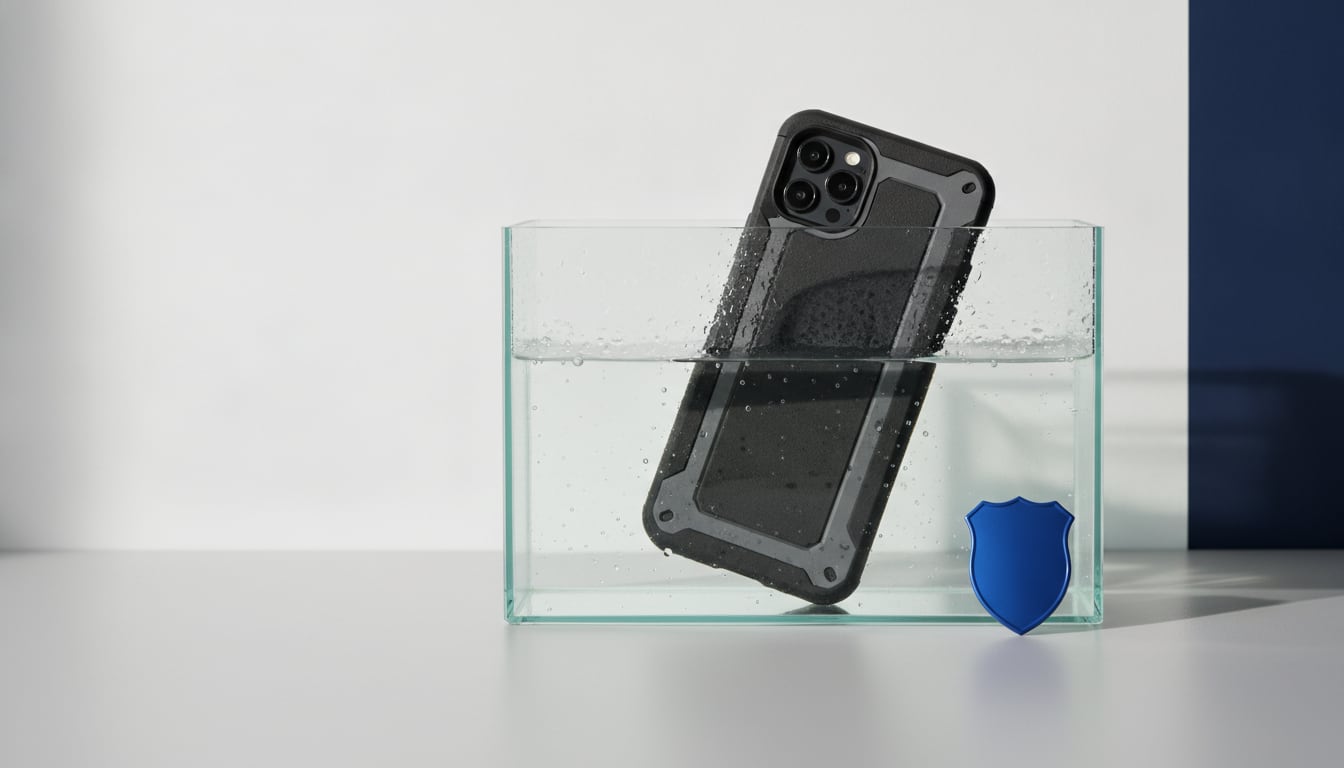
The four electronics claims that most often lack a test basis on Amazon, what the FTC substantiation standard asks of each, and how to word each so it holds up.
Electronics copy is full of claims that sound like specifications but are actually promises. "Waterproof." "Military grade." "UL certified." "100 W super fast charging." Each one is an objective statement that a regulator would ask you to prove, and each one shows up on listings where the proof is a supplier's word. Amazon can suppress a listing on a competitor's complaint about any of them, UL polices its mark directly, and the FTC's substantiation rules apply to a $25 Bluetooth speaker as fully as they do to a health product.
This article takes the four claim families the electronics rule pack checks most often, explains what each actually asserts, and shows how to say the true version.
The standard behind all four
The FTC's Advertising Substantiation Policy is short: an advertiser must have a reasonable basis for an objective claim before making it. Under FTC Act Section 5, a claim without that basis is deceptive. The amount of evidence scales with the claim. "Rugged case with reinforced corners" is descriptive and needs nothing. "Drop tested to 1.2 m" is an objective test claim and needs the test. "Certified" is a claim that a named third party has certified the product, and needs the certificate.
Our guide to what clinically proven actually requires covers the same framework for health claims. The electronics version is the same rule with different test standards, and the pattern of failure is identical: the claim grows in the copy while the evidence stays wherever the factory left it.
1. Waterproof and IP ratings
The IP code under IEC 60529 is a defined test. The second digit is the water rating, and each level means one specific thing:
- IPX4 is splash-resistant from any direction.
- IPX5 and IPX6 are water jets of increasing force.
- IPX7 is immersion to 1 m for 30 minutes.
- IPX8 is immersion beyond 1 m under conditions the manufacturer defines, which is why "IP68" on its own tells a buyer very little.
None of them covers diving, hot water, soap, salt water or pressure from swimming strokes unless the manufacturer states and tested for it. The rule pack flags three patterns:
- "Waterproof" or "100% waterproof" with no IP rating or test standard named. This is an unqualified absolute claim, and the word has no defined meaning.
- An IP rating whose meaning is overstated. "Waterproof smartwatch for swimming and diving, IP68" stretches a rating that may have been tested at 1.5 m in still water into an activity it never covered.
- "Waterproof" on a product whose ports or speakers obviously cannot be sealed. An open USB-A port and a waterproof claim do not belong on the same product.
A stated rating with a matching description is acceptable on its own. "IPX7 waterproof speaker" passes. "IP67 waterproof: submersible to 1 m for 30 minutes (IEC 60529 tested)" passes and tells the buyer what they are getting. The test report is what you keep on file to back it; the pack lists an IP-rating report as a required document whenever the claim appears.
2. Military grade and MIL-STD-810
"Military grade" is either an objective claim or puffery, and in a bullet point it reads as the former. If it means anything, it means the product was tested to MIL-STD-810, the US Department of Defense environmental test standard. Three things to know about that standard:
- It is a collection of test methods, each with procedures and parameters the tester chooses. Method 516 is shock, including the drop test; Method 510 is sand and dust; Method 506 is rain.
- There is no certification program. Nobody certifies a product to MIL-STD-810. "MIL-STD-810G certified" is therefore a claim about a certification that cannot exist.
- The useful claim names the method, the procedure, the parameters and the lab. "Drop tested to MIL-STD-810H Method 516.8, 26 drops from 1.2 m, by an independent lab" is a claim you can substantiate with one report.
The rule flags "military grade" stated as a fact without a test basis and any "certified" wording, and ignores descriptive ruggedness language with no standard invoked. If your case is tough and you have no test, say it is tough. If you have a test, say what it was.
3. UL, ETL and CSA claims
A UL, ETL or CSA mark is a statement that a Nationally Recognized Testing Laboratory certified the product to a named safety standard. It is the strongest claim in this list, because a specific company stands behind it, and that company enforces its mark. UL LLC does act on misuse, and Amazon removes listings on UL complaints.
The rule in the electronics pack treats every such claim as requiring the NRTL certificate, naming the product model and the standard, to be on file. Four fictitious examples it would flag:
| Listing text | Why it is flagged |
|---|---|
| "UL approved power strip" | Wrong wording; UL does not approve. Also no certificate on file |
| "UL certified charger for fast and safe charging" | Certification claim with no standard and no certificate linked |
| "UL 2849 certified e-bike, certificate E123456" | Correct shape, but the certificate still has to be on file and match the model |
| "Uses a UL-listed AC adapter" | Component claim; the adapter certificate is what needs to be on file |
Two wording points. "UL approved" is never correct: UL lists, recognizes or certifies. And a reference to a standard is not a certification claim: "designed to meet 62368-1" and "overcharge and short-circuit protection built in" are not flagged, because they claim no third-party mark.
For e-bikes, e-scooters and hoverboards, the certification is not optional marketing but a condition of sale in several jurisdictions; our guide to UL 2849 and UL 2272 on Amazon covers that.
4. Fast-charging wattage and protocol claims
Charging claims combine physics with trademarks, and fail on both.
Wattage the hardware cannot deliver. A USB-A port cannot deliver 100 W. A 100 W USB-C claim needs a cable rated for 5 A, which means an e-marked cable; a listing that promises 100 W and ships a 3 A cable is promising something the box cannot do.
Comparisons with no basis. "3x faster" and "super fast charging for all phones" need a protocol and a comparison point. Faster than what, on which device, using which standard?
Protocol certifications you may not hold. Quick Charge is Qualcomm's program. USB PD certification is run by USB-IF. MFi is Apple's. Each requires membership and testing, and each name is a trademark. "Quick Charge 4.0 certified" on a charger whose maker never joined the program is a false certification claim and a trademark problem. "Supports USB PD 3.0" is a specification; "USB PD certified" is a claim about a program.
Charge-time claims with no conditions. "0 to 80% in 30 minutes" depends on the device, its battery, the cable and the starting temperature. "Charges iPhone 15 to 50% in 30 minutes (Apple figure)" states the device and attributes the number.
The rule reports nothing for plain, consistent specifications. "20 W USB-C PD charger" is fine. The findings come from the adjectives.
Where these claims hide
The text fields are the obvious place, but all four claim families turn up in two others that sellers forget:
- Backend search terms. "Waterproof military grade" in the hidden keywords is still a claim on the listing.
- Image text. The IP68 badge in an infographic, the shield icon that says MIL-SPEC, the UL-style logo a designer drew because it looked right. Rendered images are read the same way as bullets, and a drawn UL mark with no certificate behind it is the worst version of the problem.
Rewriting without losing the sale
The selling point survives every one of these fixes. The claim gets precise instead of big:
- "100% waterproof" becomes "IPX7: survives immersion to 1 m for 30 minutes".
- "Military grade protection" becomes "Drop tested to MIL-STD-810H Method 516.8 by an independent lab" if you have the report, or "Reinforced corners and a raised bezel" if you do not.
- "UL approved" becomes "UL Listed to UL 62368-1, certificate on file" when it is true, and disappears when it is not.
- "100 W super fast charging for all phones" becomes "65 W USB-C PD 3.0; includes a 5 A e-marked cable".
A listing that makes only the claims its documents support is also a listing that survives a competitor complaint, which is one of the common ways listings in the electronics category get suppressed. Verid8 reads the text, search terms and image text of every listing for these four claim families, quotes each finding with what would substantiate it, and tracks the IP report, MIL-STD report and NRTL certificate each claim needs on file.
Frequently asked questions
Can I say my speaker is waterproof if it has an IP rating?
State the rating and describe what it means. IPX7 covers immersion to 1 m for 30 minutes, not diving or hot water. Waterproof with no rating is an unqualified absolute claim, and an IP rating stretched past its definition is overstated.
Is it misleading to say MIL-STD-810 certified?
Yes. MIL-STD-810 is a set of test methods with no certification program, so nothing is MIL-STD-810 certified. A defensible claim names the method and procedure and the lab that ran it, for example drop tested to Method 516.8 by an independent lab.
What is wrong with UL approved?
UL lists, recognizes or certifies products; it does not approve them. UL approved is incorrect wording, and any UL, ETL or CSA claim needs the certificate naming your product model and the standard on file. UL enforces its mark and Amazon removes listings on UL complaints.
Can I describe my charger as Quick Charge or USB PD certified?
Only if you are in the program. Quick Charge, USB PD certification and MFi are trademark or certification programs that require membership and testing. A charger that supports the protocol can say so; certified is a different claim.
This article is general information for Amazon sellers, not legal advice. Regulations and Amazon policy change; verify requirements against the primary sources cited, and consult a qualified attorney about your specific situation.